Clinically verified
The content of this article has been verified by the specialist team of the Sztuka Harmonii Psychological Centre.
EEG Biofeedback in Gdansk - How to Choose a Good Practice?
Interest in neurofeedback in Poland is growing year by year. An increasing number of practices in the Tri-City area offer this service, and patients face the question: how to choose a center that can be trusted? The neurofeedback market in Poland is unregulated - there is no official registry of certified therapists, and neurofeedback equipment can be purchased by practically anyone. This means the quality of services can vary greatly.
What to Look for When Choosing a Specialist?
The first and most important issue is the therapist's education. Neurofeedback is a method that intervenes (indirectly, through learning) in brain functioning. Therefore, it should be conducted by a specialist with solid preparation. The minimum is a completed degree in psychology, medicine, or a related field plus specialized neurofeedback training. Ideal qualifications include a degree in psychology or medicine, completed certified training in EEG Biofeedback or neurofeedback (e.g., BCIA - Biofeedback Certification International Alliance programs, or certified Polish training programs), clinical experience working with patients with specific difficulties (ADHD, insomnia, anxiety), and the ability to read and interpret EEG recordings.
Ask directly about qualifications. A good specialist will have no problem answering. If someone says that neurofeedback is simple and anyone can do it - that is a red flag.
Equipment Matters
Not all neurofeedback systems are created equal. The market offers professional devices (e.g., NeuroAmp, Neurofield, BrainMaster, Thought Technology) and consumer devices (e.g., Muse, Emotiv), which are suitable at most for assisted meditation, not for clinical therapy. The difference lies in EEG signal quality, number of channels, software, and protocol configuration capabilities.
A professional practice should have medical-grade equipment of Class II or higher, supporting a minimum of 2-4 EEG channels (for standard protocols) or 19 channels (for QEEG and advanced protocols), with certified analysis and training software, regularly calibrated and serviced.
You do not need to understand equipment technically - but it is worth asking what system the practice uses. Professional therapists are happy to talk about their equipment.
Individualized Approach vs. Template Protocols
This is a key difference between a good and an average practice. Some centers use one universal protocol for all patients - regardless of the problem, age, and EEG profile. This approach is cheaper and simpler but significantly less effective.
A good center starts with diagnosis. Before the first training session, a detailed history should be gathered, and ideally a QEEG (quantitative electroencephalogram) analysis performed - a computerized analysis of the EEG recording compared to a normative database. Based on this, the therapist selects a training protocol tailored to the specific patient. During the cycle, parameters should be regularly verified and corrected based on progress.
Questions Worth Asking Before Signing Up
Before scheduling the first session, it is worth asking about several specific things. What is your educational background and what neurofeedback training have you completed? What equipment do you use? Do you perform QEEG or another form of diagnostics before training? How many sessions does a typical cycle involve and how often do meetings take place? Is the protocol individually customized? How do you monitor progress during therapy? What is your experience working with my specific problem (ADHD, insomnia, depression)?
A professional center will answer these questions concretely and without evasion. If you hear only generalities - it is worth looking further.
Neurofeedback Prices in Gdansk
Session prices for neurofeedback in the Tri-City area typically range from 120 to 250 PLN per session. Several factors influence the price: practice location (city center vs. outskirts), therapist qualifications (psychologist vs. someone with brief training), equipment quality, session duration, and QEEG availability.
Remember that the cheapest option is not necessarily the best value. Saving several dozen zloty per session, multiplied by 30 meetings, can prove illusory if therapy is conducted inadequately and does not produce results. On the other hand - a high price alone does not guarantee quality.
Some practices offer packages (e.g., 10 or 20 sessions at a lower per-session price). This is a reasonable option if you are confident in the center's quality - you save money and immediately commit to regular visits, which improves therapy effectiveness.
Neurofeedback and Public Health Insurance Coverage
Currently, neurofeedback is not covered by the National Health Fund in Poland. It is a private service. Some health insurance plans (e.g., as part of corporate packages) may partially cover costs, but this is the exception rather than the rule. It is worth checking the terms of your insurance - sometimes neurofeedback falls under the broad category of neurological rehabilitation.
Patient Experiences in Gdansk
Patients who have used neurofeedback in the Tri-City area most often share their experiences in the context of specific changes in daily life. Parents of children with ADHD report better school performance, calmer evenings, and fewer conflicts. Adults with insomnia report that for the first time in years they fall asleep in less than 30 minutes. People with anxiety describe that situations that previously triggered panic now cause only mild unease.
Of course, experiences are individual. Not every patient achieves spectacular results, and some require a longer cycle or additional support. That is why the initial consultation is so important - it allows for a realistic assessment of what can be expected in a specific situation. A good specialist does not promise miracles - they say what is possible and clearly communicate the method's limitations.
Neurofeedback for Seniors in Gdansk
A growing group of neurofeedback patients in the Tri-City area are seniors. Research shows that neurofeedback can support cognitive functions in elderly individuals: improving working memory, information processing speed, and the ability to sustain attention. Angelakis and colleagues in a 2007 study demonstrated that neurofeedback training improved cognitive test scores in healthy seniors. While neurofeedback is not a cure for dementia or Alzheimer's disease, it may slow cognitive decline and improve the quality of daily functioning in people at the stage of mild cognitive impairment (MCI).
How Does Therapy Proceed Step by Step?
In a good center, the process looks as follows. Initial consultation - a conversation about difficulties, gathering a history, establishing goals. EEG or QEEG diagnosis - analysis of the brainwave profile, comparison with norms. Establishing the training protocol - the therapist selects parameters based on the diagnosis. Training sessions - 2-3 times per week, each 45-60 minutes. Regular reviews - every 10 sessions, discussion of progress and possible protocol correction. Final session - assessment of results, recommendations for further management.
Online or In-Person?
In the era of telemedicine, the question arises whether neurofeedback can be done online or at home. Consumer devices (e.g., Muse, NeuroSky) are available on the market that offer a simplified version of neurofeedback for home use. Is this an alternative to office visits?
The short answer: no. Consumer devices have a limited number of channels (often one), lower signal quality, and do not allow for individual protocol customization. They can be useful as a meditation support tool, but do not replace professional neurofeedback with multi-channel EEG, certified software, and supervision by a qualified therapist. Clinically significant effects - improvement in ADHD attention, insomnia reduction, decreased anxiety - were achieved in studies using professional equipment in office settings. There is no comparable data for home devices.
Some professional centers are beginning to offer hybrid models: diagnosis and initial sessions in-office, followed by some sessions using borrowed professional equipment at home, under remote therapist supervision. This is a promising direction, but it is not yet widespread in Poland.
The Role of a Comprehensive Approach
Neurofeedback on its own is a valuable method, but its effectiveness increases when it is part of a thoughtful therapeutic plan. A good practice does not offer neurofeedback in a vacuum. It should have the ability to refer patients for additional consultations - psychological, psychiatric, neurological - when the situation requires it.
Ask about this at the initial consultation. Does the practice collaborate with a psychologist, psychiatrist, neurologist? If needed, can I receive additional support, or do I have to find it on my own? A center that offers comprehensive care is more credible than a one-person practice that does only neurofeedback and nothing else.
Neurofeedback in the Tri-City Area - Availability and Locations
In Gdansk, Gdynia, and Sopot, there are several dozen practices offering neurofeedback. Some are one-person offices, while others are larger psychological centers with teams of specialists. When choosing, it is worth considering not only the quality of the service but also logistics: is the practice accessible by public transportation? Do the opening hours fit your schedule? Is there parking? Neurofeedback requires regular visits - 2-3 times per week for several months - so convenience of travel really matters.
It is also worth asking about appointment availability. Popular practices can be booked weeks in advance. If you need to start therapy quickly, ask about the waiting time for the first session and the possibility of reserving regular time slots for the entire cycle.
Red Flags - When to Keep Looking
Finally, a list of warning signs that should raise caution. Promises of miraculous results: neurofeedback helps, but it is not a cure-all. If someone promises to cure your child's autism in 10 sessions - run. No diagnostics before training: if the practice proposes starting training from the first visit, without a history and EEG analysis - that is a serious red flag. Without diagnosis, it is impossible to know what protocol to select. One protocol for everyone: if every patient - regardless of the problem - receives the same training scheme, it means the practice does not individualize its approach. Reluctance to answer questions: a professional therapist gladly explains their qualifications, methods, and expected results. If you sense resistance or evasive answers - keep looking. No progress monitoring: if nobody asks how you feel between sessions, does not conduct reviews every 10 sessions, and does not correct the protocol - that indicates a lack of professional approach to therapy.
EEG Biofeedback at Sztuka Harmonii Psychological Center
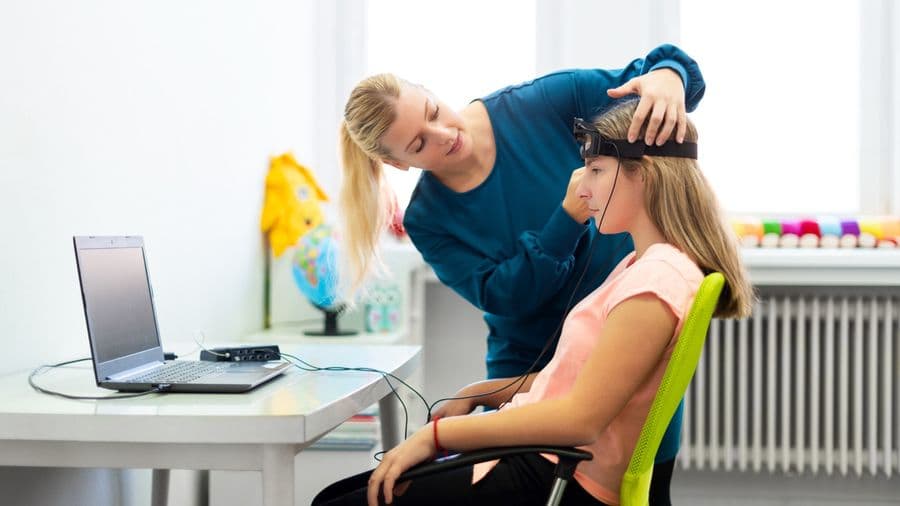
At Sztuka Harmonii Psychological Center, we offer EEG Biofeedback sessions as part of a comprehensive approach to mental health. Magdalena Raba, MA, the center's owner and psychologist, conducts initial consultations and oversees the entire therapeutic process. Neurofeedback here is part of a broader offering - when needed, we combine it with psychological consultations, psychotherapy, or ADHD diagnosis.
We accept patients at four Tri-City locations: Piekarnicza 5 in Gdansk (main office), Bergiela 4/10 in Morena, Wajdeloty 28/202A in Wrzeszcz, and 10 Lutego 7/103 in Gdynia. Call 732 059 980 to schedule the first conversation. We will answer all questions and help assess whether neurofeedback is appropriate for your situation.