Clinically verified
The content of this article has been verified by the specialist team of the Sztuka Harmonii Psychological Centre.
What Is EEG Biofeedback and How Does This Method Work?
EEG Biofeedback - also known as neurofeedback - is a training method that allows a person to learn conscious regulation of the electrical activity of their own brain. It sounds complicated, but the idea itself is simple: the brain generates electrical waves at different frequencies, and these frequencies correspond to different mental states. Beta waves are associated with concentration and attention, alpha with relaxation and calmness, theta with drowsiness and daydreaming, and delta with deep sleep. When these proportions become disrupted - for example, too much theta during wakefulness, which makes focusing difficult - specific difficulties in daily functioning appear.
Neurofeedback utilizes the principle of operant conditioning. A brain that receives real-time feedback about its activity begins to learn - just like a muscle we train at the gym. This does not require willpower in the traditional sense. Learning occurs largely outside conscious control, although the patient actively participates in the process.
What Does an EEG Biofeedback Session Look Like?
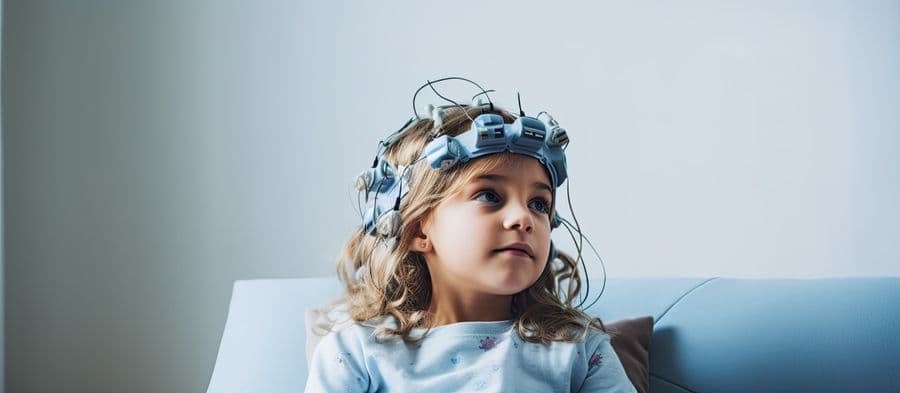
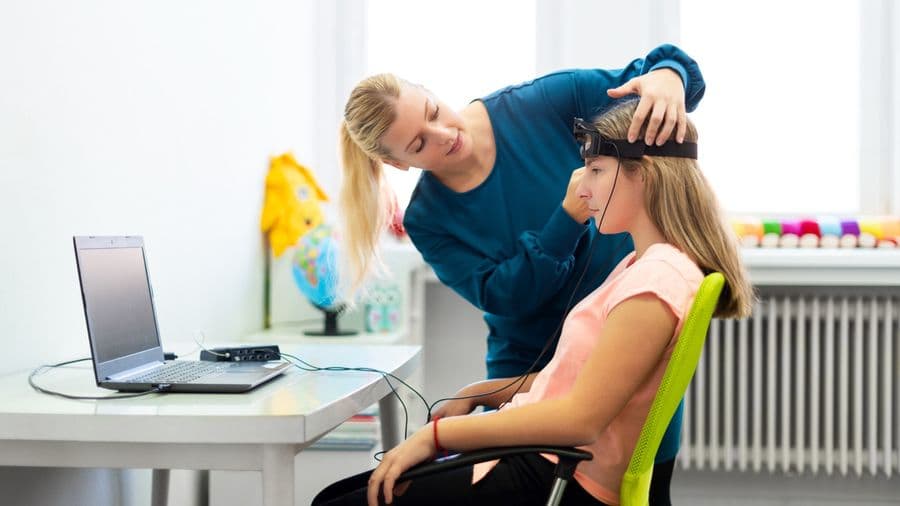
Electrodes are placed on the patient's head - usually from one to several, depending on the training protocol. The electrodes do not send any impulses to the brain. They only read the EEG signal and transmit it to a computer. This is an important distinction: neurofeedback is a completely non-invasive method. The brain is not stimulated externally - it learns on its own based on feedback.
On the monitor screen, the patient sees a visualization - it can be a game, a movie, or an animation that responds to changes in brain activity. When the brain produces the desired wave pattern, the image becomes brighter, the game progresses forward, the sound intensifies. When activity deviates from the target - the image darkens, the game stops. The brain, seeking reward, begins producing more of the desired patterns. From session to session, this new pattern becomes consolidated.
A typical session lasts 45 to 60 minutes, of which the actual training is about 20-30 minutes. The remaining time is for preparation - attaching electrodes, setting parameters - and discussing the session with the therapist.
What Problems Can Be Treated with Neurofeedback?
Neurofeedback is used for a wide range of difficulties. The strongest scientific evidence concerns working with ADHD. The American Academy of Pediatrics recognized neurofeedback as early as 2012 as an intervention with the highest level of recommendation (Level 1 - Best Support) in the treatment of ADHD in children and adolescents. Research shows improvement in attention, reduction in impulsivity, and decreased hyperactivity - effects that persist after therapy ends.
Beyond ADHD, neurofeedback is effectively used for sleep disorders and insomnia, depression and low mood, anxiety disorders, difficulties with concentration and memory, migraines, post-traumatic stress disorder (PTSD), as well as peak performance training - improving cognitive performance in healthy individuals, athletes, musicians, and executives.
Who Can Benefit from EEG Biofeedback?
The method is suitable for both adults and children - typically from 5-6 years of age, when a child is able to sit still for the duration of the session. There is no upper age limit. Neurofeedback is sometimes used with seniors to support cognitive function and slow degenerative processes.
It is worth knowing that you do not need to have a diagnosed disorder to benefit from neurofeedback. An increasing number of people treat it as a form of mental training - a way to improve concentration, stress resilience, or sleep quality. Just like physical exercise - you do not need to be ill to benefit from it.
How Does EEG Biofeedback Differ from Other Methods?
Unlike pharmacotherapy, neurofeedback does not introduce any chemical substances into the body. The effects result from brain learning, not from external modulation of neurotransmitters. This means the method does not have the typical side effects associated with medications.
Neurofeedback also differs from psychotherapy, although both methods can complement each other. Psychotherapy works with content - thoughts, emotions, beliefs, experiences. Neurofeedback works with process - with the electrical activity of the brain itself, regardless of content. For many patients, combining both approaches yields the best results.
It is also worth distinguishing neurofeedback from transcranial brain stimulation (tDCS, TMS). The latter are stimulation methods - they send impulses to the brain from the outside. Neurofeedback, on the other hand, relies solely on learning - the brain regulates its own activity based on feedback.
What Does the Scientific Research Say?
The scientific foundation of neurofeedback has been growing since the 1960s, when Professor Barry Sterman at UCLA accidentally discovered that cats trained to increase production of SMR (sensorimotor rhythm) waves were resistant to epileptic seizures. Since then, hundreds of clinical studies have been conducted.
The meta-analysis by Arns and colleagues from 2009, encompassing 15 studies and over 1,000 ADHD patients, demonstrated a large effect size for inattention (0.81) and impulsivity (0.69), and a medium effect size for hyperactivity (0.40). Subsequent studies, including randomized controlled trials (RCTs), confirmed these results - although they emphasize that the best outcomes come from combining neurofeedback with other forms of therapy.
In the area of insomnia, the study by Cortoos and colleagues from 2010 showed that SMR training improves sleep quality and shortens sleep onset latency. In depression, protocols based on alpha asymmetry (increasing left frontal lobe activity) show promising results, although the scientific base is smaller than for ADHD.
How Long Does a Full Therapy Cycle Last?
This is one of the most frequently asked questions. A standard neurofeedback cycle typically consists of 20-40 sessions, conducted 2-3 times per week. Some patients notice the first effects after as few as 5-10 sessions, although full stabilization requires completing the entire cycle. The number of sessions depends on the problem, its severity, and the individual brain's response to training. For ADHD in children, a typical cycle is 30-40 sessions. For insomnia, 15-25 sessions often suffice.
Before starting training, the therapist conducts an initial assessment - gathering a history, analyzing the EEG profile, and based on this, selecting the training protocol. During the cycle, parameters are regularly adjusted according to the patient's progress.
Types of Training Protocols
There is no single universal neurofeedback protocol. The therapist selects the training scheme based on the patient's EEG profile and their difficulties. The most commonly used protocols include SMR training (sensorimotor rhythm, 12-15 Hz) - which strengthens calm concentration and the ability to relax. It is widely used for insomnia, ADHD, and general tension. Theta/beta training - which reduces slow theta waves while simultaneously strengthening fast beta waves. This is the most popular protocol for working with ADHD. Alpha asymmetry training - which balances activity between the left and right frontal lobes. It is used mainly in depression, where asymmetry disfavoring the left side is characteristic. Alpha-theta training - which brings the brain into a state of deep relaxation at the boundary between sleep and wakefulness. It is sometimes used in working with trauma, addictions, and in creativity training. Low beta training (12-20 Hz) at specific locations - which supports executive functions, planning, and decision-making.
A good therapist does not limit themselves to one scheme throughout the entire cycle. As progress is made, they modify parameters - for example, starting with SMR training to stabilize sleep, and then transitioning to beta training to improve concentration. This flexibility is one of the indicators of a quality practice.
Is Neurofeedback for Everyone?
Neurofeedback is a safe and widely used method, but - like any intervention - it has its limitations. It is not recommended as the sole treatment method in acute psychotic states. With uncontrolled epilepsy, it requires close collaboration with a neurologist. In cases of severe depression with suicidal ideation, a psychiatric consultation and pharmacological stabilization take priority - neurofeedback can enter the picture as a complement, not as the first line of defense. But for the vast majority of people - both with and without disorders - neurofeedback is safe, non-invasive, and free from serious side effects.
What to Expect at Your First Visit?
The first visit to a neurofeedback practice is typically an initial consultation, not a training session right away. The therapist gathers a history: asking about the current problem, its history, previous treatment, medications, co-existing conditions, and lifestyle. This conversation typically lasts 45-60 minutes and serves to assess whether neurofeedback is an appropriate direction.
If the therapist determines that training is indicated, the next step is usually an initial EEG recording. The patient sits in a chair, electrodes are placed on the head, and the computer records a few minutes of brain activity - once with eyes open, once with eyes closed. This recording allows the therapist to see the baseline brainwave profile and select the training protocol.
The actual training begins at the second or third visit. There is no pain, no discomfort. Most patients say the session is pleasant and relaxing. The only things worth remembering are to arrive well-rested (a sleep-deprived brain learns less effectively) and to avoid caffeine just before the session (coffee changes the EEG profile and can interfere with training results).
Frequently Asked Patient Questions
Does neurofeedback hurt? No. The electrodes only read the signal. They do not send any impulses to the brain. The only discomfort is a slight sensation of the electrodes adhering to the scalp, which disappears immediately upon their removal.
Are the effects permanent? Yes - provided the full training cycle is completed. The brain learns a new pattern that, after a sufficient number of repetitions, becomes automatic. Follow-up studies demonstrate the persistence of effects for 6-12 months and longer after therapy ends.
Can neurofeedback be combined with medication? Yes. Neurofeedback does not interact with pharmacotherapy. Many patients use both methods simultaneously. As training progresses, a psychiatrist may decide to gradually reduce medication dosages.
Is neurofeedback covered by public health insurance? Currently, no. It is a private service. The cost of a session in Gdansk typically ranges from 150 to 250 PLN. Some private insurance plans may partially cover the costs.
EEG Biofeedback at the Sztuka Harmonii Psychological Center
At Sztuka Harmonii Psychological Center in Gdansk, we conduct EEG Biofeedback sessions for both adults and children. Magdalena Raba, MA, the center's owner and psychologist, oversees the diagnostic process and helps select the optimal therapeutic approach - combining neurofeedback with psychological consultations when needed. Julia Augustyniak, MA, a specialist in the area of ADHD, collaborates on cases where neurofeedback is part of a broader therapeutic plan that includes diagnosis and coaching.
We accept patients at four locations: Piekarnicza 5 in Gdansk (main office), Bergiela 4/10 in Morena, Wajdeloty 28/202A in Wrzeszcz, and 10 Lutego 7/103 in Gdynia. If you would like to learn whether EEG Biofeedback is appropriate for your situation, call 732 059 980 or schedule an initial consultation through our website. The first conversation will help us assess whether this method is a good direction and plan the next steps.