Clinically verified
The content of this article has been verified by the specialist team of the Sztuka Harmonii Psychological Centre.
EEG Biofeedback for Children - When Is It Worth Considering This Method?
Parents who hear about EEG Biofeedback for the first time usually have two questions: is it safe for a child and does it really work. The answer to both is yes - although, as with any therapeutic method, it is worth knowing the details in order to make an informed decision. This article is for parents who are considering neurofeedback for their child and want to know what to expect.
How Does Neurofeedback Work in Children?
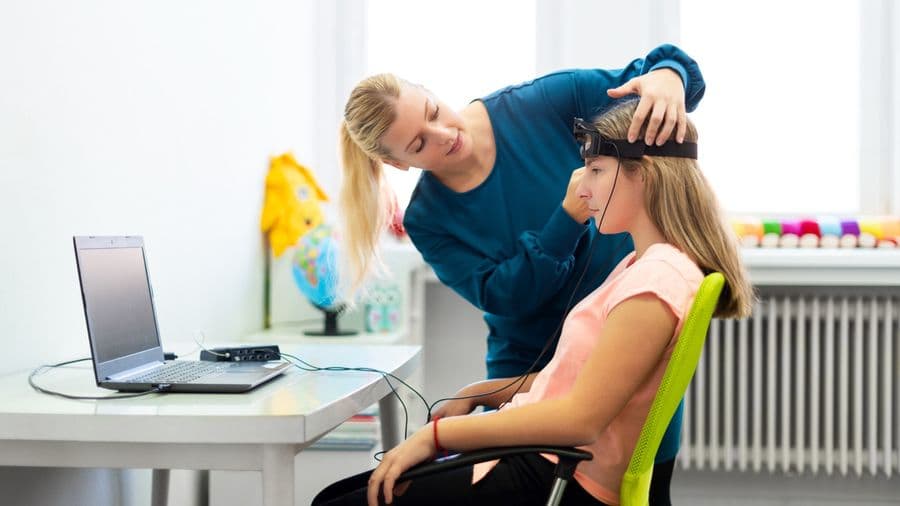
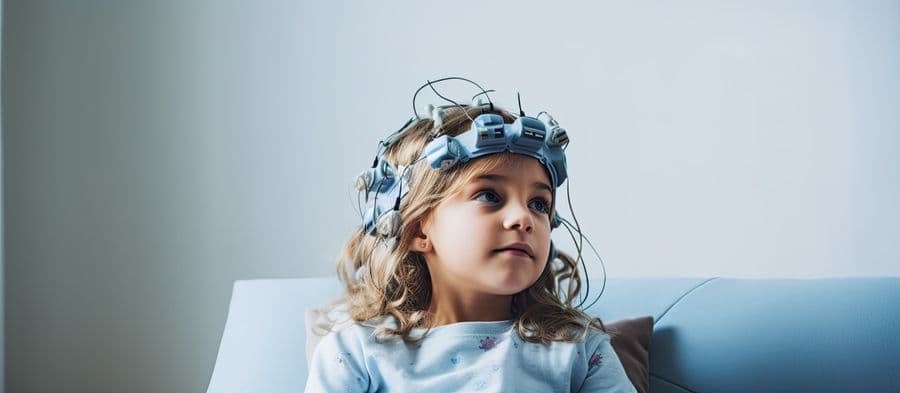
A child's brain is exceptionally plastic. This means that it creates new neural connections and learns new patterns more easily than an adult brain. This means children often respond to neurofeedback faster and more strongly than adults. The mechanism is simple: electrodes are placed on the child's head (they do not hurt, they do not send any impulses) that read the brain's electrical activity. This activity is displayed on the screen in the form of a game - when the brain produces the desired waves, the game progresses, the character flies forward, the car accelerates. When the brain returns to old patterns - the game slows down.
The child does not need to understand the mechanism. They do not need to try hard or think about brainwaves. Learning occurs at a subcortical level - the brain automatically seeks reward and begins producing patterns that generate it. It is like learning to ride a bicycle - nobody consciously thinks about each muscle movement, yet the body learns all the same.
What Problems Does Neurofeedback Help Children With?
The strongest evidence concerns ADHD. Meta-analyses confirm that neurofeedback improves attention, reduces impulsivity, and decreases hyperactivity in children with this disorder. But this is not the only application.
Neurofeedback for children is effectively used for difficulties with concentration and attention - even without a formal ADHD diagnosis, sleep problems - difficulty falling asleep, restless sleep, waking during the night, anxiety disorders - excessive anxiety, phobias, separation anxiety, difficulties with emotional regulation - anger outbursts, tearfulness, difficulty calming down, muscle tension and somatic stress symptoms - stomach aches, headaches without medical cause, as well as academic difficulties resulting from attention deficits or excessive arousal.
Some centers also use neurofeedback in working with children on the autism spectrum, epilepsy (as a complement to pharmacological treatment), or learning disorders. In these cases, the scientific base is smaller, but clinical results can be promising.
From What Age Can a Child Use Neurofeedback?
The practical lower limit is 5-6 years of age. This is not due to the safety of the method - neurofeedback is safe regardless of age - but because younger children may have difficulty sitting still for the duration of the session (20-30 minutes of active training). Some exceptionally calm four-year-olds manage well, but that is rather the exception.
There is no upper age limit. Neurofeedback is used with adolescents (especially during puberty, which can be emotionally turbulent), as well as with adults and seniors.
What Does the Process Look Like from a Practical Perspective?
Before starting training, an initial consultation takes place - with the parents and with the child. The therapist gathers a history: what difficulties are you observing, since when, in what situations do they intensify, what previous attempts at help have been made. Then an EEG recording is performed, which allows the therapist to see the child's brainwave profile and select the training protocol based on this.
Sessions typically last 45-50 minutes (including preparation). The actual training is 20-30 minutes in front of the screen. The recommended frequency is 2-3 times per week. The full cycle usually encompasses 25-40 sessions. After every 10 sessions, the therapist conducts a review - discussing progress with the parents, gathering information about changes observed at home and at school, and modifying training parameters if needed.
Important: the parent does not leave the child alone. During the initial sessions, the parent's presence in the office is natural and recommended - the child feels safer, and the parent can see what the process looks like. Over time, most children feel comfortable and eagerly come to subsequent sessions on their own.
Does Neurofeedback Replace ADHD Medication?
This question comes up very often and requires an honest answer. Neurofeedback is not a substitute for medication in the sense that it does not work immediately. Medication takes effect the same day. Neurofeedback requires weeks of systematic training before effects become visible. That is why in many cases both methods are used simultaneously - medication provides ongoing support, while neurofeedback works toward lasting change in brain functioning.
Some parents choose neurofeedback precisely because they do not want to give their child medication - and that is their right. Research confirms that neurofeedback used on its own (without medication) produces significant improvement in children with ADHD. However, this is not the only right path. The decision about pharmacological treatment is made by a child psychiatrist in consultation with the parents, taking into account the severity of symptoms and the child's situation.
What to Expect After the First Sessions?
One should not expect an immediate revolution. The first 5-10 sessions are typically a phase in which the brain learns to recognize the new pattern. Some children may be slightly tired after a session - this is a normal reaction to intense neuronal work, comparable to fatigue after athletic training. Others feel more relaxed right away.
Real, visible changes - such as improved concentration during lessons, calmer evenings, easier falling asleep - typically appear after 10-15 sessions. Full stabilization of new patterns requires completing the entire training cycle. It is important not to interrupt therapy after the first successes - the brain needs repetitions for the new pattern to become lasting.
What Do Parents Say?
Feedback from parents whose children have completed a full neurofeedback cycle is most often positive. Parents report that the child focuses better on homework, is calmer at home, falls asleep more easily, less frequently has anger outbursts, and manages better in interactions with peers. Many say that if they had known sooner, they would have started long ago.
Of course, not every child responds the same way. Approximately 20-30% of children may require a longer cycle or additional support - for example, psychological therapy addressing the emotional aspects of their difficulties. That is why it is important for neurofeedback to be part of a thoughtful plan, not the only intervention.
Neurofeedback and Other Forms of Support for Children
Neurofeedback works best as an element of a broader support plan. For children with emotional difficulties, it is worth considering combining neurofeedback with psychological therapy, which helps the child understand and express emotions. For children with ADHD - with psychoeducation for the family, which teaches how to adapt the home and school environment to the child's needs. For children with academic difficulties - with pedagogical therapy, which addresses specific learning deficits.
At Sztuka Harmonii, we ensure that neurofeedback is not the only intervention, but part of a thoughtful plan. Julia Augustyniak, MA, an ADHD specialist, helps parents understand what additional forms of support may be needed and how to coordinate them with neurofeedback training. This approach requires more planning but produces more lasting and deeper effects than neurofeedback on its own.
The Role of Parents in a Child's Neurofeedback Therapy
Neurofeedback is not a method where you hand the child over to the therapist and wait for results. Parental involvement is crucial at every stage. Before starting - parents provide information that helps the therapist understand the child's difficulties and select the appropriate protocol. During therapy - parents observe changes in the child's daily functioning and report them to the therapist. This is invaluable data, because the therapist sees the child for 45 minutes during a session, while parents see them for the rest of the day. After completion - parents help maintain new habits and patterns.
Good communication between parents and the therapist is the foundation of effective therapy. It is worth asking questions, requesting explanations, and sharing observations. No question is foolish - especially when it concerns a child's health.
Neurofeedback and School
Many parents wonder whether it is worth informing the school that their child is undergoing neurofeedback training. It is an individual decision, but in many cases it is worthwhile. A teacher who knows that the child is working on improving concentration can more consciously observe progress and adjust expectations. Some schools in the Tri-City area are open to collaborating with specialists - the therapist can prepare a brief note for the homeroom teacher describing what the child is working on and what kinds of changes to expect.
It is also worth remembering that neurofeedback requires regular visits - 2-3 times per week. When planning sessions, one must take into account the child's lesson schedule, extracurricular activities, and time for rest. Afternoon sessions, right after school, are often the optimal solution.
How Long Do Effects Last in Children?
This is one of the most important questions from parents. The research is promising here. Gevensleben and colleagues in a follow-up study from 2010 demonstrated that the effects of neurofeedback in children with ADHD were maintained 6 months after the end of therapy without additional sessions. Other studies suggest even longer persistence of effects - up to 2 years after completing the cycle. This is a clear advantage over pharmacotherapy, where the effect disappears immediately after discontinuation.
Why are the effects lasting? Because neurofeedback changes the way the brain self-regulates - it creates new neural connections, strengthens existing pathways. This is not a temporary modulation of brain chemistry, but a lasting structural and functional change. A child's brain, which is exceptionally plastic, is particularly good at consolidating these new patterns.
In some children - especially those with more severe ADHD symptoms or co-occurring disorders - the therapist may recommend booster sessions: once a month or once a quarter for several months after the main cycle ends. This is not a necessity, but an option that can strengthen the durability of effects.
Can Neurofeedback Help with Academic Difficulties?
Academic difficulties are a common reason parents seek neurofeedback. A child who cannot focus during lessons, confuses letters, has difficulty memorizing material - is not necessarily lazy or lacking ability. Often behind this lie attention deficits or sensory processing issues that neurofeedback can address. Training that strengthens beta waves at frontal locations improves the ability to sustain attention during tasks. SMR training improves the ability to sit still and work in a focused manner. Alpha training helps with arousal regulation - a child who is less tense absorbs knowledge more easily. An important caveat: neurofeedback is not a substitute for pedagogical or speech therapy if the child has specific learning difficulties (dyslexia, dysgraphia, dyscalculia). However, it can serve as a valuable complement, improving the foundational attention and regulation functions upon which the learning process depends.
EEG Biofeedback for Children at Sztuka Harmonii
At Sztuka Harmonii Psychological Center in Gdansk, we have been working with children for years. We understand that the decision about a child's therapy can be difficult and raises many questions. That is why we start with a thorough conversation with the parents - without obligations and without pressure. Magdalena Raba, MA, conducts initial consultations, during which she discusses the child's situation and together with the parents determines whether neurofeedback is a good direction. Julia Augustyniak, MA, supports the process from the diagnostic side, especially when we suspect ADHD or other difficulties requiring in-depth assessment.
We accept patients at our office at Piekarnicza 5 in Gdansk, at Bergiela 4/10, at Wajdeloty 28/202A in Wrzeszcz, and at 10 Lutego 7/103 in Gdynia. Call 732 059 980 to schedule the first conversation. We are happy to answer all questions.