Clinically verified
The content of this article has been verified by the specialist team of the Sztuka Harmonii Psychological Centre.
EEG Biofeedback for Insomnia - How Does Brain Training Improve Sleep Quality?
You lie in bed and cannot fall asleep. Thoughts chase one after another, the body is tired, but the brain will not shut off. You glance at the clock - two in the morning. Three. Four. You get up in the morning feeling broken, knowing that another day will be a struggle. If this sounds familiar, you are not alone. Insomnia is one of the most common health problems - according to research, it regularly affects one in three adults.
Why Won't the Brain Let You Fall Asleep?
Falling asleep is not a decision - it is a neurobiological process. It requires the brain to transition from a waking state (beta wave dominance) through a state of relaxation (alpha wave dominance) to a state of drowsiness (theta wave dominance) and finally to deep sleep (delta wave dominance). In people with insomnia, this process is disrupted. The brain is stuck on too high a gear - it produces an excessive amount of fast beta waves, while the alpha and theta waves that should calm it down in the evening are too weak.
EEG studies of people with insomnia reveal several characteristic patterns: elevated beta activity (high beta, above 20 Hz) - the brain is in a state of constant vigilance, reduced SMR activity (sensorimotor rhythm, 12-15 Hz) - there is a deficit of waves responsible for calm wakefulness and the transition to sleep, disruptions in transitioning between waking and sleeping states - the brain has difficulty changing gears.
Pharmacotherapy - sleeping pills such as zolpidem or zopiclone - chemically forces a state change but does not teach the brain how to fall asleep. After discontinuing medication, the problem returns, often with a vengeance (so-called rebound insomnia). Neurofeedback approaches the problem from the other side: it teaches the brain to independently transition into a state conducive to falling asleep.
How Does Neurofeedback Help with Insomnia?
The primary protocol used for insomnia is SMR (sensorimotor rhythm) training at the Cz point (vertex of the head). SMR is a frequency band of 12-15 Hz waves, associated with calm wakefulness, body relaxation while maintaining mental clarity. Research by Barry Sterman - a pioneer of neurofeedback - demonstrated that increasing SMR activity improves the ability to transition from wakefulness to sleep.
The SMR protocol works in several ways: it reduces excessive cortical arousal (too much beta), strengthens the brain's ability to self-regulate, improves sleep stability - fewer nighttime awakenings, and increases the proportion of deep sleep (N3 stage). In addition to SMR, alpha-theta training is sometimes used - deep relaxation in which the brain transitions between alpha (calm wakefulness) and theta (drowsiness) states. This protocol is particularly useful when insomnia is associated with intrusive thinking, rumination, or anxiety.
What Does the Research Say?
The study by Cortoos, De Valck, Arns, Breteler, and Cluydts from 2010, published in the Journal of Sleep Research, demonstrated that individuals with insomnia who underwent 18-20 SMR training sessions significantly shortened their sleep onset latency and improved subjective sleep quality compared to the control group. Importantly, effects were maintained at follow-up measurement.
The study by Hoedlmoser and colleagues from 2008 demonstrated that SMR training increased sleep spindle density - a physiological marker of sleep stage quality - by 37% in participants, and sleep onset latency shortened by an average of 11 minutes.
The systematic review by Mercier, Pivik, and Bharda from 2022, encompassing 14 studies, found moderate to large effects of neurofeedback in improving sleep quality in individuals with primary insomnia. The authors emphasized that neurofeedback is particularly valuable for patients who do not want to or cannot use pharmacotherapy.
What Does the Process Look Like from a Practical Perspective?
A typical neurofeedback cycle for insomnia encompasses 15-25 sessions, conducted 2-3 times per week. At the beginning, the therapist gathers a detailed history concerning sleep patterns: what time you go to bed, how long it takes to fall asleep, how many times you wake up during the night, what time you get up, whether you have used sleeping pills, and whether you have other health problems.
Then an initial EEG recording is performed to see the patient's brainwave profile. Based on this, the therapist selects the training protocol - typically SMR at Cz, sometimes combined with reducing high beta.
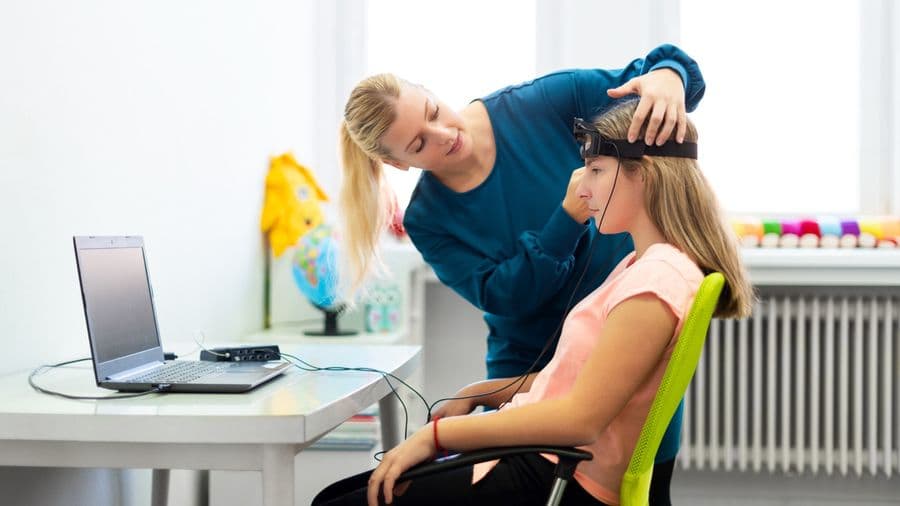
During the session, the patient sits comfortably in a chair, has electrodes on their head, and sees a visualization on the screen that responds to brain activity. The session lasts 45-50 minutes, of which active training is 20-25 minutes. Many patients say that the session itself is relaxing - which is not surprising, because SMR training teaches the brain to enter a state of calm quieting.
When Will Effects Appear?
The answer is individual, but a certain pattern recurs. The first changes - easier falling asleep, less tension in the evening - appear in many patients after 5-8 sessions. Improved sleep continuity (fewer nighttime awakenings) comes somewhat later, typically after 10-15 sessions. Full stabilization of the new sleep pattern requires completing the entire cycle.
It is important not to interrupt training after the first successes. The brain needs repetitions for the new pattern to become automatic - just as with learning any other skill. Premature termination of therapy is the most common reason effects do not last long-term.
Neurofeedback and Other Methods for Treating Insomnia
The gold standard for treating insomnia is CBT-I (Cognitive Behavioral Therapy for Insomnia). It includes sleep hygiene, sleep restriction, stimulus control, and cognitive restructuring. CBT-I is effective in approximately 70-80% of patients and is recommended as first-line treatment by most clinical guidelines.
Neurofeedback and CBT-I are not mutually exclusive - quite the opposite. CBT-I works on behaviors and beliefs about sleep. Neurofeedback works on brain activity itself. A patient who simultaneously changes their sleep habits and trains their brain toward better self-regulation can achieve deeper and more lasting improvement than with either method alone.
Sleeping pills should be used only short-term and under medical supervision. For insomnia lasting months or years, they do not solve the problem - they only mask the symptoms. Neurofeedback offers an alternative that addresses the cause, not the effect.
Types of Insomnia and Their Significance for Neurofeedback
Not all insomnia is the same. Specialists distinguish several types, and understanding them has significance for neurofeedback protocol selection. Sleep-onset insomnia (difficulty falling asleep) is the most common form. The patient goes to bed and lies there for an hour, two, before falling asleep. The EEG shows elevated beta activity - the brain cannot shut off. SMR training and reducing high beta are particularly effective here.
Early morning awakening insomnia means the patient falls asleep normally but wakes at four or five in the morning and cannot fall back asleep. This type of insomnia often co-occurs with depression. A protocol addressing frontal alpha asymmetry may be more appropriate here than SMR alone.
Sleep maintenance insomnia (frequent nighttime awakenings) - the patient falls asleep but wakes up multiple times during the night. Sleep is fragmented and non-restorative. The EEG often shows unstable transitions between sleep stages. SMR training helps stabilize these transitions by increasing sleep spindle density.
Mixed insomnia combines features of several types. In practice, this is the most common form - the patient both takes long to fall asleep and wakes during the night and gets up tired in the morning. It requires a multicomponent protocol, adjusted during the cycle.
Insomnia and Other Mental Health Problems
Insomnia rarely occurs in isolation. According to epidemiological research, as many as 80% of people with insomnia have co-occurring difficulties: anxiety, depression, chronic stress, ADHD, or trauma-related disorders. This is important information, because treating insomnia alone - without addressing its causes - often produces short-lived results.
Neurofeedback has the advantage that training protocols can be tailored to co-occurring problems. If insomnia is associated with anxiety - the therapist adds high beta reduction. If with depression - alpha asymmetry training. If with ADHD - strengthening beta waves responsible for concentration. This flexibility allows addressing insomnia not as an isolated symptom but as an element of a broader clinical picture.
At Sztuka Harmonii, we ensure that before starting neurofeedback, we thoroughly understand what lies behind sleep difficulties. Magdalena Raba, MA, during the initial consultation asks questions not only about sleep but about overall functioning - mood, anxiety level, concentration, life experiences. This comprehensive assessment allows for more accurate protocol selection and better therapy outcomes.
Sleep Hygiene as a Foundation
Neurofeedback is an effective tool, but it works best in combination with basic sleep hygiene principles. Even the best brain training will not help if someone drinks three espressos at eight in the evening, scrolls through their phone in bed, and goes to sleep at a different time every day. Therefore, during the neurofeedback cycle, it is worth maintaining a consistent bedtime and wake time, even on weekends. Limiting caffeine from the afternoon hours is crucial, because the half-life of caffeine is 5-6 hours, which means coffee consumed at three in the afternoon is still active at nine in the evening. Screens should be turned off at least one hour before sleep - blue light inhibits melatonin production. The bedroom should serve only for sleep, not for work, eating, or watching movies. An evening relaxation routine, such as a warm bath, reading a book, or a brief meditation, helps the brain switch into calming mode.
These principles sound simple, but their consistent implementation can significantly improve sleep quality on its own. Neurofeedback amplifies this effect, teaching the brain to enter states conducive to falling asleep even when thoughts try to race.
How to Measure Progress in Insomnia Treatment?
Objective assessment of progress in insomnia therapy requires tools. The simplest is a sleep diary - daily noting: what time you went to bed, how long it took to fall asleep, how many times you woke during the night, what time you got up, how you rate sleep quality on a 1-10 scale. After several weeks of keeping a diary, patterns emerge, and improvement becomes measurable.
A more advanced tool is actigraphy - wearing a device on the wrist (resembling a watch) that records body movements at night. This allows for objective measurement of sleep onset latency, number of awakenings, and sleep efficiency. Not every practice uses actigraphy, but if you have a smartwatch or fitness band with sleep monitoring functionality - data from it can be a valuable supplement of information for the therapist.
In the context of neurofeedback, progress is also measured by comparing EEG recordings from the beginning and end of therapy. If at the beginning, high beta waves dominated (excessive arousal), and after 20 sessions the proportions shifted toward SMR and alpha - that is objective evidence that the training worked at a neurophysiological level.
Help at Sztuka Harmonii Psychological Center
At Sztuka Harmonii Psychological Center, we help people with insomnia by combining neurofeedback with psychological consultations. Magdalena Raba, MA, conducts the initial assessment and helps determine whether the source of insomnia is stress, anxiety, depression, or other factors - because the selection of the appropriate training protocol depends on this.
If insomnia is affecting your daily functioning and you are looking for a method that does not rely on sleeping pills, call 732 059 980 and schedule a consultation. Together we will determine what therapeutic plan will be best for your situation.