Clinically verified
The content of this article has been verified by the specialist team of the Sztuka Harmonii Psychological Centre.
Biofeedback vs. Neurofeedback - How Do These Methods Differ?
Biofeedback and neurofeedback are terms that often appear side by side and are sometimes confused. No wonder - both end in "feedback" and both involve a person receiving information about processes occurring in their body. The difference lies in exactly which processes are monitored and trained. This distinction has practical significance: it determines which method will be appropriate in a given situation.
What Is Biofeedback?
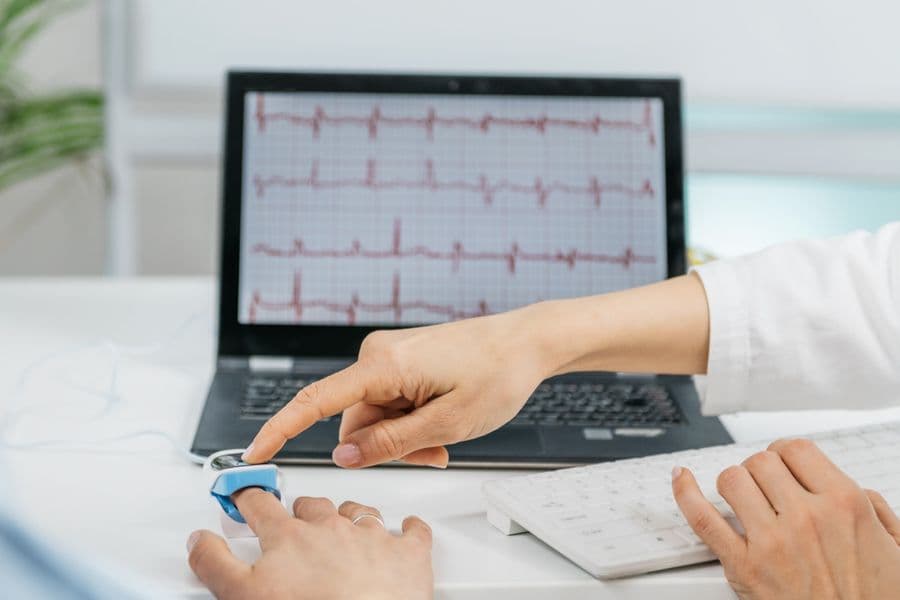
Biofeedback is a general term for a group of methods in which the patient learns conscious regulation of physiological processes based on real-time feedback. Sensors placed on the body measure specific physiological parameters and display them on the screen in a comprehensible form - as charts, animations, or sounds. The patient, seeing this data, learns to influence processes that normally occur outside conscious control.
The main types of biofeedback are: EMG biofeedback (electromyography) - measures muscle tension. Electrodes are placed on muscles (most commonly the neck, shoulders, forehead) and the patient learns to consciously relax them. It is used for treating tension headaches, bruxism, stress-related muscle tension, and post-accident rehabilitation. HRV biofeedback (heart rate variability) - measures the variability of intervals between heartbeats. Higher variability indicates better adaptability of the organism and greater stress resilience. HRV training involves synchronizing breathing with heart rhythm - which activates the parasympathetic nervous system and reduces the stress response. GSR biofeedback (galvanic skin response) - measures the electrical conductance of the skin, which changes under the influence of emotional sweating. It is used in the treatment of anxiety disorders and phobias. Thermal biofeedback - measures finger temperature (which drops under stress due to peripheral vasoconstriction). The patient learns to dilate blood vessels, which reduces tension and improves circulation. It is used for migraines and Raynaud's disease. Respiratory biofeedback - measures the frequency, depth, and pattern of breathing. It teaches conscious transition to diaphragmatic breathing, which activates the relaxation response.
What Is Neurofeedback?
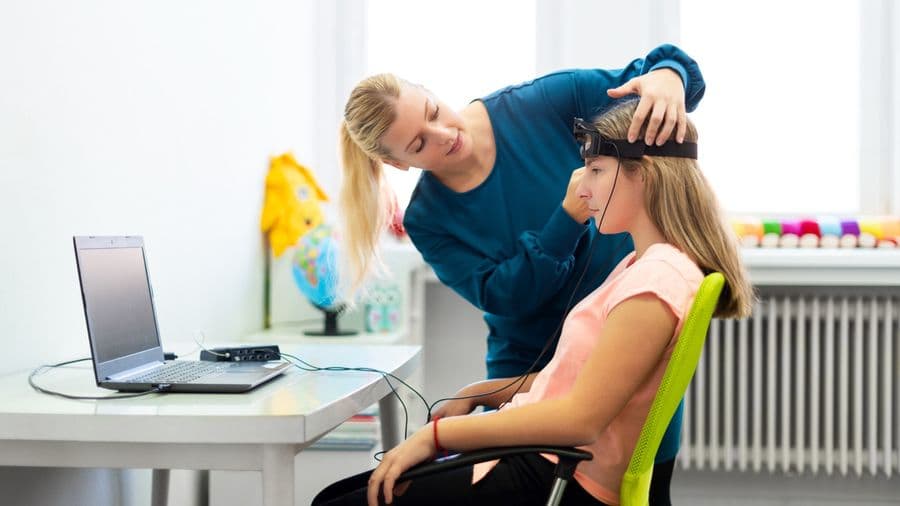
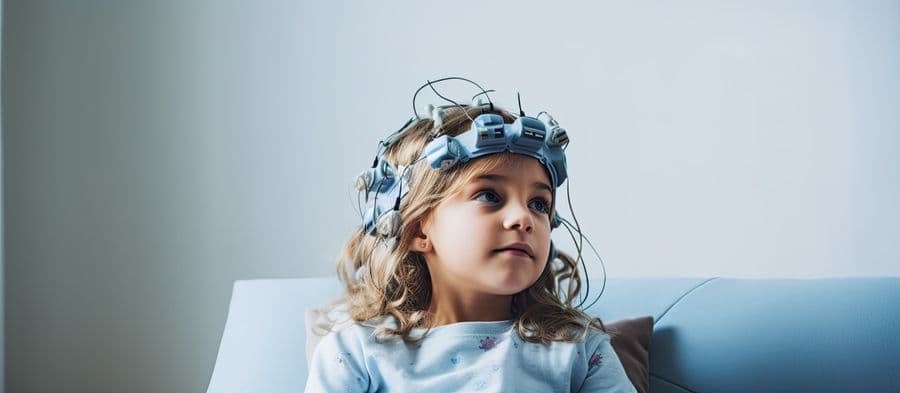
Neurofeedback - also known as EEG Biofeedback - is a special type of biofeedback that measures and trains the electrical activity of the brain (brainwaves). Electrodes are placed on the head, and a computer analyzes the EEG signal in real time. The patient sees a visualization of their brainwaves on the screen and learns to regulate them.
This is the key distinction: biofeedback in the broad sense encompasses the body (muscles, heart, breathing, temperature, skin conductance). Neurofeedback encompasses exclusively the brain. Neurofeedback is a subset of biofeedback, just as cardiology is a subset of medicine.
The learning mechanism is the same: operant conditioning. The organism (or the brain) receives a reward for a desired pattern and over time this pattern becomes consolidated. The difference lies in what we train - the peripheral nervous system (biofeedback) or the central nervous system (neurofeedback).
When to Use Biofeedback and When Neurofeedback?
The choice depends on the problem the patient presents with. Biofeedback (body) is indicated when the main problem is muscle tension - tension headaches, bruxism, neck and shoulder tension. EMG biofeedback teaches muscles to relax. It also works well when stress manifests primarily in the body - heart palpitations, shallow breathing, cold hands, excessive sweating. HRV and respiratory training help regulate the autonomic stress response. Biofeedback is useful in rehabilitation after injuries and strokes - EMG helps rebuild muscle control - and in migraines, where thermal biofeedback is one of the best-documented non-pharmacological methods.
Neurofeedback (brain) is indicated when the problem lies in attention and concentration regulation - ADHD, learning difficulties, distractibility. Brainwaves responsible for attention can be directly trained. It is appropriate when difficulties concern sleep - insomnia, difficulty falling asleep, shallow sleep. Neurofeedback teaches the brain to transition into states conducive to falling asleep. Neurofeedback is also the method of choice when the goal is mood and emotion regulation - depression, anxiety, irritability, emotional dysregulation - because these processes are regulated centrally, at the brain level.
Can Both Methods Be Combined?
Yes, and an increasing number of centers do this. An example scenario: a person with chronic stress experiencing simultaneously neck muscle tension (a peripheral symptom), insomnia (a central symptom), and low mood (a central symptom). Such a person can benefit from EMG biofeedback for the neck muscles and simultaneously from SMR neurofeedback for sleep improvement. HRV training can complement both approaches, teaching better autonomic system regulation.
Combining peripheral biofeedback with neurofeedback produces a multi-level effect: we work simultaneously with the body and the brain. For many patients, this is the most comprehensive approach.
How to Choose the Right Method?
The best way is a consultation with a specialist who knows both methods and can assess what will be most beneficial in a given case. It is worth describing your symptoms - both physical (muscle tension, headaches, heart or breathing problems) and psychological (difficulties with attention, sleep, mood, anxiety) - so the therapist can propose an optimal training plan.
You do not have to choose at the first meeting. The initial consultation is a time for conversation, assessment of the situation, and jointly determining what makes the most sense. Sometimes one method is sufficient. Sometimes the best results come from combining several.
Clinical Examples - When Biofeedback, When Neurofeedback?
To better illustrate the difference, let us consider several typical situations. Patient A: a 35-year-old IT professional, tension headaches 3-4 times a week, neck and shoulder tension, grinds teeth at night. His problem is primarily peripheral - chronically tense muscles. Best approach: EMG biofeedback on the frontal, temporal, and neck muscles. Goal: teach the muscles to relax, reduce tension as a habit.
Patient B: a 28-year-old medical student, intense exam anxiety, insomnia, difficulty concentrating while studying, intrusive thoughts about failure. Her problem is central - the brain is in a state of constant vigilance, cannot calm down. Best approach: neurofeedback - reducing high beta, strengthening SMR and alpha. Goal: teach the brain to transition from an alarm state to a state of calm focus.
Patient C: a 50-year-old executive, chronic stress, heart palpitations, sweaty palms, insomnia, irritability, neck muscle tension. His problem is multi-level - it encompasses both the body (heart, muscles, sweating) and the brain (insomnia, irritability). Best approach: combining HRV biofeedback (autonomic stress response regulation) with SMR neurofeedback (sleep improvement and cortical arousal reduction). Goal: simultaneous work with the body and the brain.
What Does the Research Say About the Effectiveness of Both Methods?
Both biofeedback and neurofeedback have a solid scientific base, though in different areas. EMG biofeedback is considered highly effective in treating tension headaches - the meta-analysis by Nestoriuc and Martin from 2007 demonstrated a large effect size. Thermal biofeedback has strong support in migraine therapy - the Association for Applied Psychophysiology and Biofeedback (AAPB) classifies it as efficacious. HRV training demonstrates effectiveness in anxiety reduction, emotional regulation improvement, and blood pressure reduction.
Neurofeedback, in turn, has the strongest evidence for ADHD (Level 1 - Best Support according to AAP), insomnia (moderate to large effect size), depression (promising data, growing research base), and epilepsy (historically the first area of application, Sterman's research). In general terms, neurofeedback is better studied in neuropsychiatric disorders, while peripheral biofeedback in psychosomatic and stress-related complaints.
History of Both Methods
Biofeedback has its roots in the 1960s, when researchers such as Neal Miller, Joe Kamiya, and Elmer Green began experimenting with teaching people conscious control of physiological processes. Kamiya was the first to demonstrate that people could learn to recognize and control their own alpha waves - this discovery gave rise to both biofeedback and neurofeedback.
Neurofeedback as a separate field emerged from the work of Barry Sterman at UCLA in the 1970s. Sterman trained cats to produce SMR waves and accidentally discovered that animals after such training were resistant to epileptic seizures induced by chemical substances. This discovery opened the door to clinical application of neurofeedback in humans - first in epilepsy, then in ADHD, insomnia, and many other disorders.
Since then, both fields have developed in parallel, but not always in harmony. For years, skepticism prevailed from mainstream medicine. Only the accumulation of data from randomized controlled trials - particularly in the last two decades - changed the tone of the discussion. Today, biofeedback and neurofeedback are recognized as evidence-based methods, although they are still not as widely known as pharmacotherapy or psychotherapy.
Practical Tips Before Your First Visit
Regardless of whether you are deciding on biofeedback, neurofeedback, or do not yet know which method will be better - several things are worth doing before your first visit. Write down your symptoms: both physical (muscle tension, headaches, heart or breathing problems) and psychological (difficulties with attention, sleep, mood, anxiety). Consider when symptoms intensify: are they related to stress at work, to specific situations, to the time of day? If you have medical test results, bring them - the therapist needs to know whether symptoms have a medical basis requiring different treatment. Do not be afraid to ask questions. A good specialist will explain why they recommend a specific method and what effects can be expected.
The Future of Biofeedback and Neurofeedback
Both methods are developing dynamically. In neurofeedback, interest is growing in new approaches: LORETA neurofeedback (training deep brain structures, not just the cortex), fMRI-based neurofeedback (training the activity of specific brain regions in real time), and network neurofeedback (training connectivity between brain areas, not just activity at one point). In peripheral biofeedback, wearable devices that monitor in real time are being developed, which can provide feedback throughout the day - not just during sessions at the practice.
These innovations are for now available mainly in research centers, but over time they will reach clinical practices. One thing is certain: both methods have solid scientific foundations and a growing evidence base. Regardless of whether you need biofeedback, neurofeedback, or both - it is worth using methods that have decades of research and clinical experience behind them.
Biofeedback and Neurofeedback at Sztuka Harmonii
At Sztuka Harmonii Psychological Center, we offer both neurofeedback (EEG Biofeedback) and elements of peripheral biofeedback as part of working with stress and tension regulation. Magdalena Raba, MA, conducts initial consultations and helps select the appropriate approach. If you do not know whether your problem requires work with the brain, with the body, or with both - that is normal. That is what the first conversation is for.
Call 732 059 980 to schedule a consultation. We accept patients in Gdansk (Piekarnicza 5, Bergiela 4/10, Wajdeloty 28/202A) and in Gdynia (10 Lutego 7/103). We are happy to explain which method will be best for your situation.